
FET vs Transformer Saturation: Why Some Compressors Sound Bigger
If you’ve ever used an analog compressor and thought, “why does this one sound huge and musical, while another sounds harsh when pushed?”—you’re not imagining things. The difference often comes down to where the character is coming from: the compression circuit itself, or the transformer that follows it.
Understanding the relationship between FET compression and transformer saturation can completely change how you choose and use a compressor in your studio.
What Is a FET Compressor?
FET (Field Effect Transistor) compressors are known for their speed, punch, and aggressive character. They react incredibly fast to incoming signals, making them ideal for drums, vocals, and any source that needs energy and presence.
Classic FET designs are prized for their ability to grab transients and add excitement—but they also have a reputation for becoming edgy or brittle when pushed too hard.
That’s because in many designs, the distortion and coloration happen directly in the FET gain reduction stage.
What Is Transformer Saturation?
Transformers are often included in high-end analog gear to add depth, weight, and harmonic richness. Unlike compression circuits, transformers don’t “control” dynamics—they shape tone.
When driven harder, a transformer begins to saturate, adding subtle harmonic content that enhances the signal rather than breaking it apart.
This results in:
- Smoother harmonic distortion
- Fuller low-end response
- More cohesive, “glued” sound
- Less harshness in the upper frequencies
Where Most Compressors Go Wrong
In many traditional FET compressors, when you push the unit harder, the distortion you hear is primarily coming from the FET circuit itself.
That can be exciting—but it can also become aggressive or fatiguing, especially on complex material like mixes, vocals, or sustained instruments.
This is why engineers often find themselves backing off just when they want more energy.
A Different Approach: Let the Transformer Do the Work
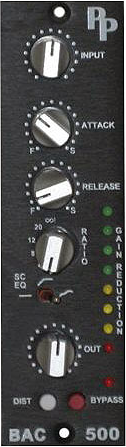
Some modern designs take a different path—allowing the FET stage to handle dynamics cleanly, while the transformer adds the character.
This is exactly what makes the BAC-500 500-series compressor stand out.
Instead of relying on FET distortion for its sound, the BAC-500 feeds into a high-quality Cinemag transformer. As you drive the compressor harder, you’re not just increasing compression—you’re saturating the transformer.
The result is a very different experience:
- More harmonically rich, musical saturation
- Clarity that stays intact even at higher levels
- A sense of size and depth rather than edge or grit
Why This Matters in Real Sessions
This distinction becomes incredibly important in real-world use.
On drums, it means you can push compression further without the cymbals turning brittle.
On vocals, it allows you to add density and presence without introducing harshness.
On mix buses or instruments, it gives you the ability to add energy while keeping everything cohesive and musical.
In other words, you’re not fighting the compressor—you’re working with it.
The “Bigger” Sound Explained
When engineers describe a compressor as sounding “big,” they’re usually hearing a combination of controlled dynamics and harmonic enhancement.
FET compression gives you control and punch. Transformer saturation gives you weight and dimension.
When those two elements are balanced correctly, the result is a sound that feels larger, more present, and more finished—even before EQ or additional processing.
Why It’s Not Just About Specs
Two compressors can have similar ratios, attack times, and features—but sound completely different depending on how their circuits interact.
That’s why experienced engineers don’t just look at specs—they listen for how a unit behaves when pushed.
Does it fall apart? Or does it come alive?
That’s the real difference.
Final Thoughts
FET compressors are a cornerstone of modern recording, but not all designs are created equal.
Understanding the difference between FET distortion and transformer saturation helps explain why some compressors feel harsh under pressure—while others get bigger, richer, and more musical.
If you’re looking for compression that enhances your sound rather than fighting it, the design matters just as much as the settings.
Because in the end, great compression isn’t just about control—it’s about tone.
Read about 'Why Your Compressor Sounds Harsh (And How to Fix It)':