
How to Use a 500-Series Compressor on Drums
Getting drums to sound punchy, controlled, and exciting is one of the biggest challenges in recording and mixing. Compression plays a huge role in shaping that sound—but it’s also one of the easiest ways to ruin it if used incorrectly.
A great 500-series compressor gives you the speed and character needed to bring drums to life—without flattening them. The key is knowing how to use it.
What Compression Does for Drums
Drum compression isn’t just about controlling peaks—it’s about shaping feel.
Done right, compression can:
- Add punch and impact to kicks and snares
- Bring out sustain and body in toms
- Control cymbals without making them harsh
- Glue the entire kit together
Done wrong, it can make your drums sound flat, lifeless, or overly aggressive.
Start with the Right Approach
Before touching any knobs, it’s important to decide what you want the drums to feel like.
Are you going for tight and controlled? Big and explosive? Smooth and glued together?
Your compression settings should support that goal—not fight against it.
Basic Settings That Work
1. Attack: Let the Transients Through
For punchy drums, avoid ultra-fast attack times. A slightly slower attack allows the initial hit of the drum to pass through before compression kicks in.
This is what gives you that “snap” on snares and impact on kicks.
2. Release: Follow the Groove
Release time should match the rhythm of the track. If it’s too fast, the compressor can sound choppy. Too slow, and it can make everything feel sluggish.
A good rule of thumb: the compressor should “breathe” with the beat.
3. Ratio: Keep It Musical
Start with moderate ratios (around 3:1 or 4:1). Higher ratios can be useful for aggressive sounds, but they can also make drums feel overly controlled if pushed too far.
4. Gain Reduction: Less Is More
For most drum applications, 2–5 dB of gain reduction is a great starting point. You can always push further—but subtle compression often sounds bigger.
Where to Use Compression on Drums
Kick and Snare
Compression here helps control peaks and add consistency. A slightly slower attack preserves punch, while a medium release keeps things tight.
Drum Bus
This is where compression really shines. A good bus compressor can glue the entire kit together, making it feel like one cohesive instrument instead of separate pieces.
Room Mics
Heavier compression on room mics can add size and excitement. This is where you can get creative and push things a bit harder.
Why the Compressor Design Matters
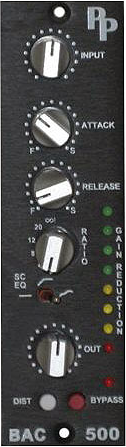
Not all compressors react the same way—especially on drums.
Fast compressors like FET designs are great for capturing transients and adding energy, but some can become harsh when pushed—especially on cymbals and overheads.
That’s where the design of the output stage becomes important.
The BAC-500 500-series compressor takes a different approach by feeding into a Cinemag transformer. Instead of relying on aggressive circuit distortion, it adds harmonic richness through transformer saturation.
This allows you to push compression further while keeping the sound smooth, punchy, and musical—especially important when working with bright drum sources.
Parallel Compression: A Powerful Trick
One of the most effective techniques for drums is parallel compression.
This involves blending a heavily compressed signal with the original, uncompressed drums. The result is a mix that feels both punchy and full—without losing dynamics.
It’s a go-to technique for modern drum sounds.
Common Mistakes to Avoid
- Using attack times that are too fast (kills punch)
- Over-compressing the drum bus
- Ignoring how compression affects cymbals
- Choosing a compressor that becomes harsh under pressure
Final Thoughts
Great drum compression isn’t about forcing control—it’s about enhancing energy.
With the right settings and the right compressor, you can bring out the natural power of a drum performance while keeping everything tight, musical, and exciting.
Once you dial it in, your drums won’t just sit in the mix—they’ll drive it.