
Why Your Compressor Sounds Harsh (And How to Fix It)
If your compressor is making things sound worse instead of better, you’re not alone. One of the most common frustrations in recording and mixing is dialing in compression—only to end up with a sound that feels brittle, aggressive, or fatiguing.
The good news? Harsh compression isn’t just “how it is.” In most cases, it comes down to a few key factors—and once you understand them, it’s surprisingly easy to fix.
What Does “Harsh” Compression Actually Sound Like?
Harsh compression isn’t always obvious at first. It often shows up as:
- A brittle or edgy high end
- Vocals that feel pushed or strained
- Cymbals that become sharp or splashy
- A mix that feels tiring to listen to over time
Instead of sounding tighter and more controlled, everything starts to feel smaller, flatter, and less musical.
The Real Reasons Compression Gets Harsh
1. Attack Is Too Fast
A super-fast attack can clamp down on transients so quickly that it removes the natural punch of a sound. When that happens, what’s left can feel dull and lifeless—often leading you to overcompensate elsewhere, which adds harshness.
2. Release Timing Is Off
If the release is too fast, the compressor can “chatter” or distort between peaks. Too slow, and it can choke the life out of a performance. Either way, the result can feel unnatural and fatiguing.
3. Too Much Gain Reduction
Compression works best in small amounts. Once you start pushing past a few dB of reduction—especially on full mixes or complex sources—the artifacts become much more noticeable.
4. The Wrong Type of Compression
Not all compressors react the same way. Some designs—especially aggressive FET-style compressors—can become edgy when pushed, depending on how they’re built.
This is where understanding the difference between compression circuits and output stages becomes important.
Why Some Compressors Stay Smooth
The key difference often comes down to where the “color” is happening.
In many compressors, pushing harder introduces distortion directly in the compression circuit. That can sound exciting at first—but it can quickly turn harsh, especially on bright or complex material.
Other designs take a more musical approach, allowing the compression stage to stay controlled while the output stage adds character.
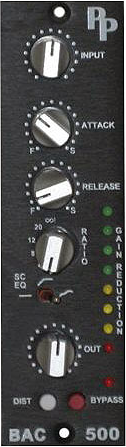
For example, the BAC-500 500-series compressor feeds into a Cinemag transformer, which means that when you drive it harder, you’re saturating the transformer—not overloading the compression circuit itself.
That results in a smoother, more harmonically rich sound that holds together—even when pushed.
How to Fix Harsh Compression (Right Now)
1. Slow Down Your Attack
Try backing off the attack time slightly. This allows transients to pass through naturally, restoring punch and reducing the need for aggressive processing later.
2. Match the Release to the Groove
Instead of guessing, listen to how the compressor breathes with the track. The release should feel like part of the rhythm—not fighting it.
3. Use Less Compression
If you’re compressing more than 3–4 dB on a full mix or bus, try backing it down. You’ll often find the sound becomes clearer and more open immediately.
4. Try Parallel Compression
Blending compressed and uncompressed signals lets you keep the dynamics while still adding control and density.
5. Choose the Right Tool
Sometimes the issue isn’t your settings—it’s the compressor itself. If a unit tends to get brittle when pushed, no amount of tweaking will completely fix that behavior.
Using a compressor that adds harmonic richness instead of harsh distortion can make a dramatic difference.
The Goal: Control Without Sacrificing Tone
Great compression should feel almost invisible. It should enhance the energy of a performance—not fight against it.
When everything is dialed in correctly, your tracks won’t just sound more controlled—they’ll feel bigger, smoother, and more cohesive.
Final Thoughts
If your compressor sounds harsh, it’s usually a sign that something is out of balance—either in your settings or in the way the compressor is designed.
By making small adjustments—and choosing tools that prioritize musicality—you can turn compression from a problem into one of the most powerful tools in your signal chain.
Because at its best, compression doesn’t just control sound—it elevates it.
Read more about the benefits of the BAC 500 over FET-only Compressors here: